


Why do societies remain calm for twenty years, only to unravel in twenty-four hours?
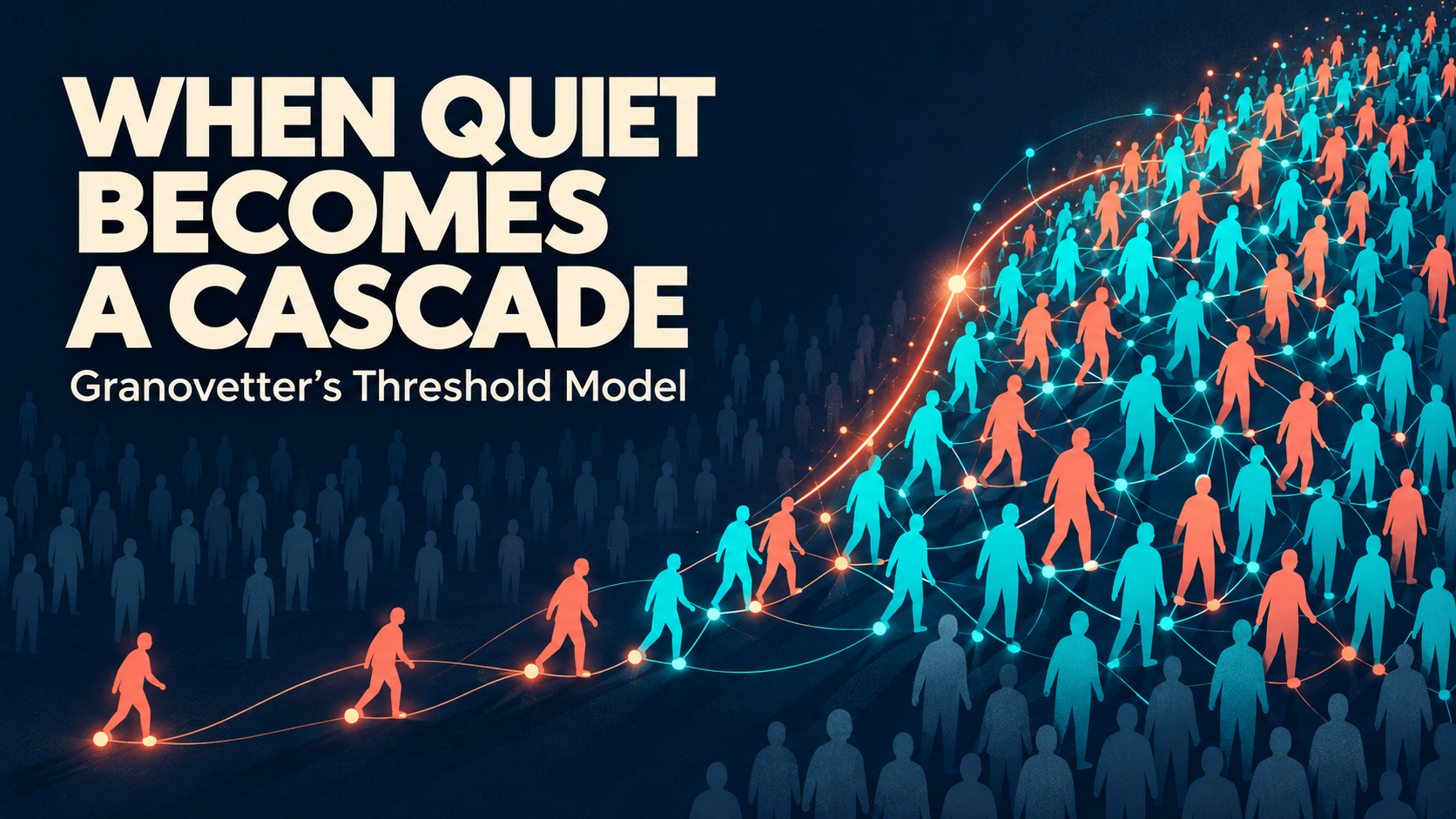
Most political upheaval isn’t about how angry a population is. It is a math problem of personal courage thresholds and game theory.
Here is how collective behavior actually works when quiet streets turn into runaway cascades:
1. Granovetter’s Threshold Model
In 1978, sociologist Mark Granovetter showed that every individual has a unique “threshold” – the exact number of people who must act before they feel safe joining in:
- T = 0 (Radicals): Will march alone in the rain with a placard.
- T = 1 (Pioneers): Need to see just one other person standing before stepping off the curb.
- T = 50 (Median Citizens): Have jobs, families, and bills. They agree with the cause, but will not risk arrest unless half the neighborhood is already in the street.
If a group has thresholds ordered 0, 1, 2, 3… an unbroken chain reaction pulls all 100 people into the street.
Remove just person 1 (through early arrest or illness), and the sequence becomes 0, 2, 3… The radical stands alone, the chain snaps instantly, and the protest dies before it starts.
2. The Coordination Trap
Game theory treats mass mobilization like the fable of belling the cat: everyone agrees change is needed, but stepping out first carries a catastrophic cost (arrest, job loss).
- Go out alone: Severe personal risk, zero outcome.
- Go out with 100,000 others: Negligible personal risk, massive institutional leverage.
Because isolation is dangerous, the default choice for rational citizens is to stay home and wait for someone else to move first – locking entire nations into decades of visible silence.
3. The Collapse of “Preference Falsification”
Under pressure, populations hide their true grievances to avoid friction. Everyone assumes: “I must be the only one this frustrated.”
When an undeniable visual signal breaks through – a shared clip, a university sit-in, or an aggressive crackdown – millions realize simultaneously that their neighbors share identical grievances.
The threshold drops overnight. The safety-in-numbers tipping point is crossed.
Recent Examples
- Dhaka (2024): Student actions ($T = 0, 1$) met heavy crackdowns, lowering the risk thresholds of previously uninvolved middle-class parents and tech workers.
- Colombo (2022): Economic collapse made the cost of staying home equal the cost of taking to the streets, flattening thresholds across social classes.
- France (2018–2023): Dispersed local hubs (roundabouts and neighborhood Telegram channels) gave small clusters safety in numbers without waiting for central union orders.
Why does this matter beyond geopolitics? Whether looking at state uprisings, virality in consumer products, or silent resistance inside corporate reorganizations: change rarely scales by convincing the majority first. It scales by ensuring the chain of early adopters remains unbroken