Archive for July 2026


When Students Rise: From Paris 1968 to Delhi 2026, The Generation That Stopped Scrolling and Started Marching
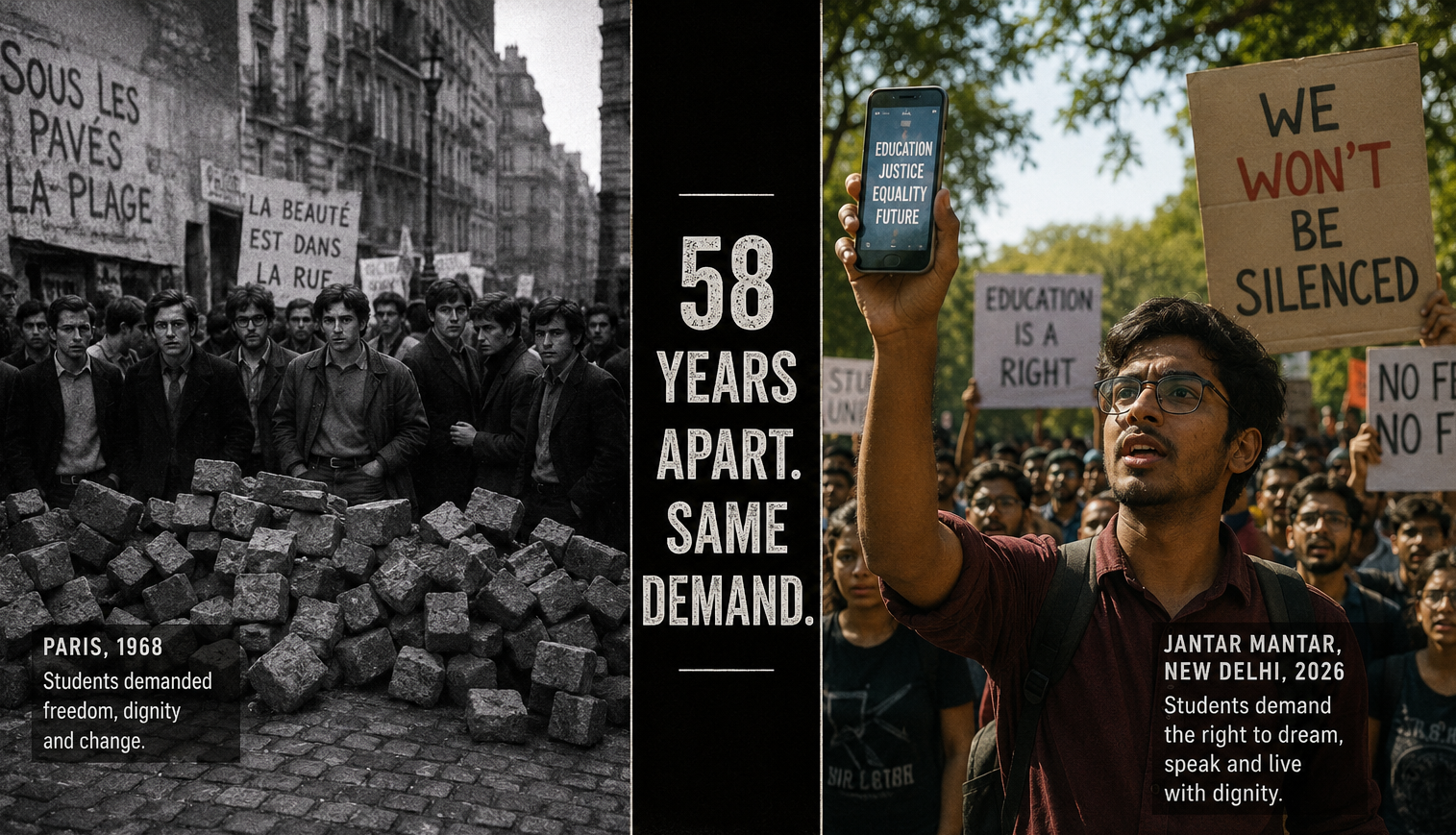
A student’s future is not tied to a single city or a single year, it cuts across geography and time. When exams are stolen by leaks, an entire generation feels betrayed. These are not abstract grievances, they are immediate threats to livelihoods, dreams, and family sacrifices. Student movements can change public debate, shape policy, and shift political fortunes.

A Future Unlinked from Geography and Time

Students today are digital natives, they grow up with feeds and timelines, they learn from screens and social media. That shared experience creates a common language and a fast pathway to mobilize. A student in Paris in 1968 and a student in Delhi in 2026 may live decades and thousands of kilometres apart, yet both can respond to the same sense of injustice. When people feel their future is being stolen, they act.

Paris 1968, When the Feed Was Conversation in Cafes

The events of May 1968 began with students at the University of Paris protesting overcrowded classes and old curricula. The police responded with force, and the response hardened public opinion. Students built barricades in the Latin Quarter, and workers soon joined them. At the height of the unrest, around ten million workers were on strike. President Charles de Gaulle called snap elections, and he won. The immediate political challenge failed, but the movement changed French society, led to university reform, improved labor conditions, and reshaped culture.

Delhi 2026, When the Question Paper Became the Crime Scene

In 2026 millions of aspirants sat for the NEET-UG exam after years of study. Then allegations of paper leaks emerged. Students and families saw the exam as a social contract, a promise that merit would matter. When that promise broke, the response was immediate and furious. Protests sprang up in Delhi and other cities, and on social media the story spread within hours.

A youth collective that calls itself the Cockroach Janta Party, using satire and viral posts, helped spark the initial wave of outrage. The group grew fast, and its campaigns moved from the scroll to the street. Activists and civil society joined, public figures added voice, and the protests demanded accountability and systemic change.

From Scroll to Street, The Power of the Social Media Feed

The social media scroll is the motif of our time. It is how information moves, how outrage crystallizes, and how people coalesce into movements. In 2026 social platforms turned private frustration into public protest. Videos of police action, testimonials from affected families, and calls for solidarity circulated widely. The feed made the movement visible to millions within hours, and it held authorities accountable in real time.

Digital tools can amplify both truth and disinformation, they can mobilize support and they can invite co-option. The generation leading the protests knows how the scroll works, and they use it to set the narrative. That ability to shape the story outside established media channels gives the movement resilience.

How Student Movements Become Powerful

  • A clear, visceral grievance that many people understand and feel
  • A state response that risks appearing heavy handed, which can broaden sympathy for protesters
  • A coalition beyond students, including workers, parents, teachers, and civil society
  • Smart use of communication channels to control the narrative, especially social media
  • Avoiding visible political capture, so the movement keeps its moral authority

Parallels Between Paris 1968 and Delhi 2026

Both movements started from specific, legitimate complaints that touched larger social issues. Both saw state actions that intensified protest. Both grew when other groups joined, and both forced national conversations about fairness, opportunity, and power. The big difference is the speed of communication. In 1968 ideas traveled through gatherings and newspapers, in 2026 the scroll spreads testimony instantly, and that changes how quickly a local grievance becomes national.

The Risk of Political Co-option

A constant danger for student movements is being seen as tools of political parties. When that happens, public sympathy erodes and the movement loses leverage. In 1968, attempts at co-option complicated the students efforts. In Delhi 2026, opposition parties have voiced support for protesters. That can be helpful in pressuring authorities, but if the movement appears controlled by party actors, it may lose the independence that gives it moral weight.

What the Government Must Understand

Governments facing student protests should not treat them as only a law and order issue, they should treat them as a demand for legitimacy. Quick fixes that punish individuals after the fact do not restore lost years. Fast track courts and stricter laws matter, but students want restoration of trust in the examination system and accountability that feels real. Heavy handed responses can turn a contained protest into a widespread political challenge.

What the Movement Needs to Protect

To keep moral authority the movement should maintain independence from formal party control, be transparent about demands and methods, and build broad coalitions that include families, teachers, and non partisan civic groups. The movement should also document events carefully, so evidence of wrongdoing or of excessive force is available to courts and to the public.

The Stakes for India

India has the largest youth population in the world, and exams are a main pathway to secure professional careers. When that pathway looks corrupt, faith in meritocracy erodes. The damage is not limited to one cohort, it can affect trust in institutions for years. Restoring trust requires open investigation, visible accountability, and structural reforms to examination systems.

Conclusion, From Scroll to Street

Student anger is not a passing trend, it is a response to broken promises. The social media scroll made a generation visible, and that visibility turned private outrage into collective action. From Paris 1968 to Delhi 2026 the lesson is clear, movements that start with a real grievance and remain independent have the power to change the public agenda. Governments should listen, respond with transparency, and restore trust. The generation that stopped scrolling and started marching is asking for fairness, they deserve a serious answer.

#StopScrollingStartMarching #TheScrollingGeneration #StudentRise #CJPProtest #CockroachJantaParty #NEETPaperLeak2026

When Bad Is Actually Good: 20 Times the Universe Played a Trick on Us

20 Times the Universe Played a Trick on Us

This morning I saw a headline that made me stop scrolling: “Northeast Delhi records 160 mm of rain as rain lashes city; ‘Good’ AQI after nearly 3 years” 160mm of rain. Waterlogging. Traffic chaos. Tree falls. Deaths. And… the cleanest air Delhi has breathed in 3 years.

That’s when it hit me. Some of the worst things in life are quietly producing some of the best outcomes.I went down the rabbit hole.

Here’s what I found.

🩺 Health & Body 

• A fever breaking a fever. High temps kill pathogens and supercharge immunity.

• Broken bones healing stronger. The callus is denser than original bone.

• Short stress sharpening you. Cortisol in bursts boosts focus and memory.

• Morning sickness protecting the baby. Linked to lower miscarriage rates.

• Scars preventing worse damage. Less elastic tissue stops wounds reopening.

🌲 Nature 

• Forest fires opening pine cones. Jack pines literally need fire to reproduce.

• Volcanoes fertilizing soil. Java, Hawaii, Italy farm on eruption ash.

• Droughts killing invasive species. Natives rebound when thirsty plants die.

• Hurricanes cooling the ocean. They churn up cold water and slow future storms

• Dead trees feeding new life. Nurse logs fuel ecosystems for decades.

🏙️ Society

• Recessions killing zombie firms. The post-2008 startup boom wasn’t a coincidence.

• Heavy traffic killing traffic. Terrible roads mean fewer drivers.

• High-crime neighborhoods spawning tight communities. Hardship builds bonds.

💻 Tech & Career 

• Software crashes forcing better architecture. Pain is the best refactor.

• Getting fired fueling better careers. Most founders cite it as the catalyst

• Memory loss protecting the brain. Amnesia can be the brain shielding itself.

🎭 Everyday Weird 

• Crying flushing stress hormones. Tears literally remove cortisol.

• A burnt tongue making other food taste incredible.

• Mosquitoes pollinating more than bees. Yes, really.

• Your immune system “practicing” on harmless dirt, building your defenses.

The lesson? We spend so much energy fighting the “bad” moments. But sometimes the worst week of your life is the one rewiring you for the best years ahead.Next time something’s falling apart, pause. The rain might be exactly what your AQI needed.

MindsetShift #Paradox #Resilience #Leadership #Growth

The Degree That Disappeared from India’s Rankings

What happens when a discipline is so interdisciplinary that it vanishes from our imagination?

Last week, I received the latest double issue of The Week. Like millions of readers, I eagerly turned to its annual rankings of India’s best colleges. Engineering. Medicine. Law. Business. Fashion. Hotel Management. Dentistry. Journalism. Architecture. Design. Virtually every discipline seemed represented.

Out of curiosity, I looked for my alma mater.

I graduated from Punjab Agricultural University, Ludhiana, in the late 1970s with a B.Sc. (Hons.) in Animal Sciences. It was one of India’s finest agricultural institutions, established during the Green Revolution, and it produced generations of scientists, administrators, entrepreneurs and policy makers who helped shape India’s food security.

But there was no category where my college belonged.

Not because it had fallen in standards.

Because the category itself had disappeared.

That prompted me to pull out my nearly fifty-year-old academic transcript. Reproduced below.

As I read through it, I realized something remarkable – not about the university, but about the education it offered.

My degree was called Agriculture Hons in Animal Sciences.

Yet the subjects I studied included:

  • Veterinary Medicine
  • Animal Physiology
  • Nutrition
  • Genetics
  • Biochemistry
  • Microbiology
  • Botany
  • Crop Production
  • Plant Breeding
  • Soil Science
  • Agricultural Ecology
  • Water Management
  • Agricultural Economics
  • Farm Management
  • Rural Sociology
  • Statistics
  • Mathematics
  • Physics
  • Food Science
  • Dairy Technology
  • English
  • Punjabi
  • Extension Education
  • Agricultural Engineering
  • Field Training

Pause for a moment.

Today these subjects belong to different schools, departments and, in many universities, entirely different campuses.

In today’s world, I would probably have needed admissions into five or six different colleges to receive the same intellectual exposure.

Yet, in the 1970s, all of this formed one coherent education.

We Have Become Masters of Specialisation

The modern university celebrates specialists.

We rank engineering colleges.

We rank medical colleges.

We rank business schools.

We rank law schools.

We rank fashion schools.

But who ranks institutions that deliberately teach students to think across biology, medicine, engineering, ecology, economics, statistics and society?

Increasingly, nobody.

And that is worrying.

The Problems We Face Refuse to Stay Inside Departments

Climate change is not an environmental problem alone.

It is an agricultural problem.

A public health problem.

An engineering problem.

An economic problem.

A behavioural science problem.

An AI problem.

Food security is not just about crops.

It is about soil microbiology, logistics, nutrition, genetics, climate, markets, public policy and consumer behaviour.

Pandemics are not merely medical events.

They involve veterinarians, ecologists, statisticians, behavioural scientists, economists and communication experts.

Yet our educational ecosystem – and even our rankings – continue to slice knowledge into increasingly narrower compartments.

What We Choose to Rank Shapes What We Choose to Value

College rankings influence students.

They influence parents.

They influence donors.

They influence policymakers.

They influence careers.

When rankings ignore interdisciplinary education, they silently tell society that such education matters less.

That may be the most damaging message of all.

The World Is Moving in the Opposite Direction

Ironically, the technologies that will define the next fifty years demand exactly the kind of education many agricultural universities quietly provided decades ago.

Artificial Intelligence.

Synthetic Biology.

Precision Agriculture.

Climate Adaptation.

Food Systems.

One Health.

Carbon Markets.

Regenerative Agriculture.

These fields do not respect departmental boundaries.

Neither does reality.

The future belongs to people who can connect disciplines – not merely master one of them.

Perhaps Agricultural Universities Were Ahead of Their Time

For decades, agricultural universities have produced graduates comfortable discussing microbes, markets, machinery, meteorology and medicine in the same conversation.

That breadth was never considered glamorous.

Today, it is becoming indispensable.

Maybe the problem is not that agricultural education became irrelevant.

Maybe our definition of relevance became too narrow.

A Challenge for India’s Ranking Agencies

Perhaps it is time for The Week, Hansa Research, NIRF and other ranking bodies to ask a larger question.

Instead of ranking only disciplines, should we also recognise institutions that produce systems thinkers?

Universities where students routinely cross the boundaries of biology, engineering, economics, environment and society.

Institutions preparing graduates for problems that do not arrive neatly labelled.

Because the future will not be built by engineers alone.

Or doctors alone.

Or economists alone.

It will be built by people who understand how all these worlds connect.

Perhaps India’s forgotten agricultural universities have been teaching that lesson for decades.

We simply stopped looking.

What do you think? Have we become so obsessed with specialisation that we’ve overlooked the value of truly interdisciplinary education? I’d love to hear from alumni of agricultural, veterinary, forestry, fisheries, environmental and other multidisciplinary institutions. What did your curriculum prepare you for that conventional rankings fail to recognise?