


The Digital Estate: How I Used AI to Turn 2 Terabytes of Chaos into a Travel Legacy
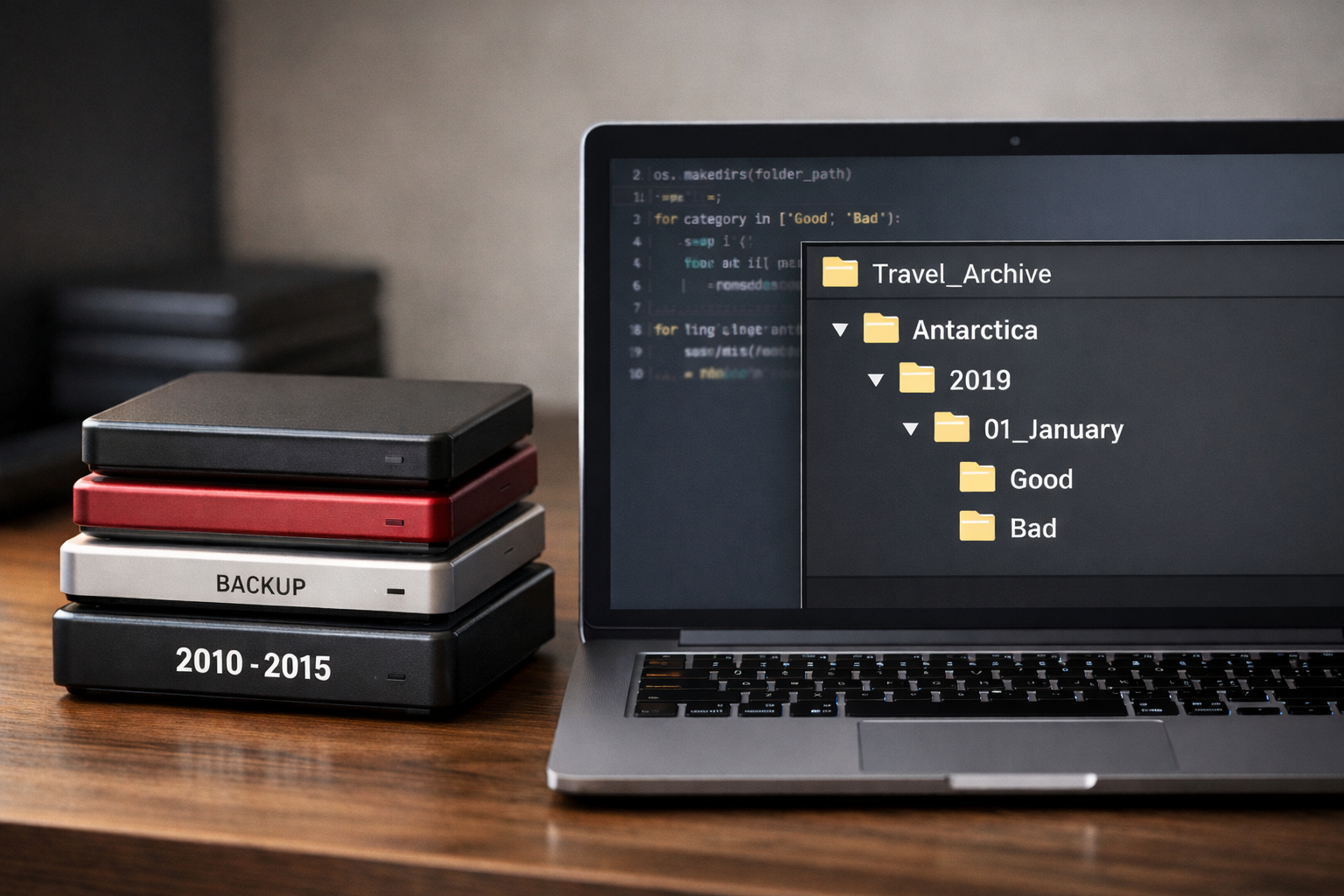
The art of travel, as any wanderer knows, is not merely in the going, but in the keeping and sharing memories. We move through the world, across the velvet plains, hills, volcanos, glaciers, deserts, oceans of seventy plus countries and the salt-sprayed edges of seven continents, gathering glimpses of the eternal like pebbles in a pocket. For years, my pockets have been digital— a lineage of silicon and glass stretching from the humble, earnest clicks of a Kodak EasyShare to Nokia 73 to Galaxy Ultras to the folded miracles of the Samsung Fold 7 and the heavy, soulful weight of Nikon and Canon mirrorless glass.
I have never claimed to be a photographer; I am simply a witness. Yet, witnesses are messy.
The Weight of Unseen Worlds
Over the decades, my wife and I have accumulated a digital ghost-library: 2 terabytes of raw light and sound. It was a labyrinth of folders—some titled by country, others merely by the name of the camera that bore witness to the scene. It was a cartographer’s nightmare. Every time I considered organizing this mountain of memory, I felt a shivering inertia. To touch those files was to be buried by the sheer volume of our own history.
The reckoning came not from a sense of order, but from a sense of mortality. While updating my Will, I realized that these files are not just data; they are my digital estate. They are the artifacts of a life lived in motion. If I did not curate them now, they would remain locked in silence forever.
The AI Intervention
A consultation with the digital oracles (DeepSeek) suggested a way forward: transform these static assets into a YouTube channel. It was the perfect vessel—a way to preserve, share, and perhaps even breathe a second life into these moments.
I hired a young enthusiast to help with the alchemy of editing, but when he saw my chaotic folder structure, he nearly pulled his hair out in despair. The bridge between my raw past and a polished future seemed impassable.
That is when I turned to Claude. If AI could not yet broker peace in our fractured world, it could, at least, bring peace to my hard drive. Within thirty minutes, it provided me with a Python script—a digital loom that wove through the metadata of my chaos.
The Great Sorting
The script was elegant in its ruthlessness. It filtered my life through a logical sieve:
- Hierarchy: Country → Year → Month.
- The Sift: Files were automatically sorted into “Accepted” and “Rejected.”
- The Standard: Anything shorter than five seconds or lower than 720p was cast aside, deemed too fleeting or too blurred for the legacy I wished to leave.
A New Horizon
The proof was in the processing. Last week, we returned from the misty heights of Patnitop and Vaishno Devi, armed with 50 GB of fresh memories across three different cameras. In the old world, it would have taken days of squinting at thumbnails to sort the wheat from the chaff.
In this new world? It took two minutes.
The “shivers” are gone, replaced by a quiet, rhythmic pulse of progress. The labyrinth is becoming a gallery. Now, finally, the stories we gathered across seventy countries can begin to find their way home.
#DigitalLegacy ,#GenerativeAI , #TravelPhotography ,#DataOrganization, #ContentCreation