


What happens if globalization begins to unwind?
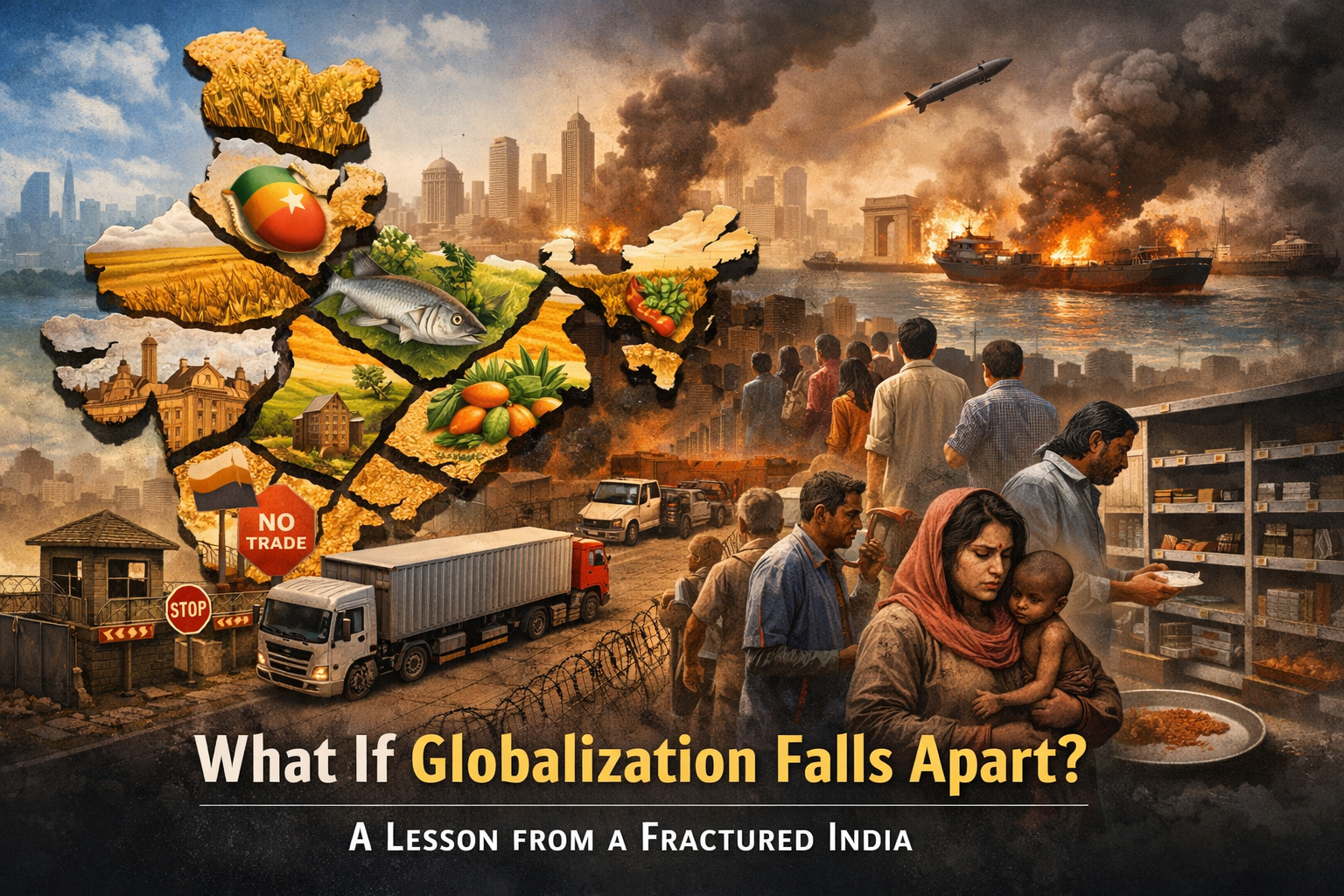
As conflicts in the Middle East threaten critical shipping routes and geopolitical trust erodes, the question is no longer theoretical: what happens if globalization begins to unwind?
Coming from a food supply chain background, I ran a thought experiment to test this theoretical premise.
Imagine for a moment that India is the entire world, and its states and Union territories are independent countries. Now imagine those borders suddenly turn hostile. Trade stops. Trucks halt. Ports close. Supply chains fracture.
Punjab grows wheat, Karnataka supplies millets, Maharashtra produces fruits, Andhra Pradesh sends seafood, and Uttar Pradesh provides vegetables and so on. Every day, millions of tonnes of food move across invisible borders to feed cities like Delhi, Mumbai, Chennai, Kolkata, and Bengaluru.
Within days, India’s largest cities—designed to function on deep interdependence rather than self-sufficiency—would face an uncomfortable question: how long can they feed themselves?
This thought experiment may sound dramatic, but it mirrors the fragility of the globalized system that runs the world today.
The Premise: “Bharat” is No More
In our current reality (Pre-Disintegration), the five major metropolitan cities are parasitic engines. They generate GDP and services but are utterly dependent on a national hinterland for survival.
- Mumbai: Relies on Gujarat (Peanuts, Onions, Milk), Karnataka (Mangoes, Vegetables), and Punjab/Haryana (Wheat).
- Delhi-NCR: The biggest consumer of Punjab and Haryana’s “Green Revolution” belt (Wheat, Rice, Milk).
- Kolkata: Dependent on the Eastern belt—Bihar (Vegetables), West Bengal (Fish, Rice), and the Northeast (Fruits, Spices).
- Chennai: Relies on the “Rice Bowl” of Tamil Nadu itself, but also Andhra Pradesh (Chillies, Vegetables) and Kerala (Coconut, Tapioca).
- Bengaluru: The Silicon Valley that eats food from Andhra Pradesh (Tomatoes, Rice), Tamil Nadu (Dairy), and Kerala (Coconut).
In our “Anarchy India,” the trucks stop at the borders. Let’s see how each city collapses.
The Worst-Case Scenario: Survival of Each City
1. Delhi (The Nation of “Dilli”)
- Dependence: 90% reliant on Punjab (Wheat) and Haryana (Milk, Vegetables).
- The Shock: Overnight, the “Nation of Hariana” and “Nation of Punjab” seal the borders. They have the grain, and they have no reason to trade with Delhi, which offers only services and bureaucracy.
- Survival Food: The Yamuna floodplains. The small-scale vegetable farming on the riverbanks will become a warzone. The city will survive on “Bathua” (Lamb’s Quarters) and wild greens growing in abandoned lots.
- Population Outcome: Mass Starvation (60% decline). The population that survives will be the one with access to the rural fringes (West Delhi, Narela) that can turn to subsistence farming. The rest will fight over grain reserves until they run out.
2. Mumbai (The Nation of “Bombay”)
- Dependence: The city is an island. It depends on the Konkan for fish, but staple grains (Rice) come from the South, and Vegetables from the Nashik district (which is now in a different “nation” of Maharashtra, but cut off by internal borders).
- The Shock: Maharashtra state, as a unified entity, breaks into rival factions (Mumbai City-State vs. Western Maharashtra vs. Vidarbha). The highways are blocked.
- Survival Food: The Arabian Sea. Mumbai will revert to a fishing village. The Koli community (original fisherfolk) will become the ruling class. They have the only protein source.
- Population Outcome: Coastal Attrition (50% decline). Starvation will be rampant, but the city might survive slightly better due to the sea. However, without rice from the mainland to eat with the fish, malnutrition (protein without calories) will cause massive health issues.
3. Kolkata (The Nation of “Kalikata”)
- Dependence: The “Rice Bowl” is right next door (Bangladesh in reality, but in our scenario, Bardhaman and the Sundarbans are now potentially hostile).
- The Shock: The Ganga/Bhagirathi river system is the lifeline. If the upriver nations (like “Bihar”) dam the water, Kolkata loses not just food but fresh water.
- Survival Food: The Sundarbans delta. Fish, crabs, and mangroves. The city will turn to the backwaters.
- Population Outcome: The Wetlands Scramble (40% decline). Kolkata might actually fare best in terms of calories because the delta is rich. However, the lack of potable water due to upstream damming and saltwater intrusion will cause a cholera and dysentery epidemic, killing more than hunger.
4. Chennai (The Nation of “Madras”)
- Dependence: Highly dependent on the Cauvery River water and surrounding districts for rice.
- The Shock: The age-old Cauvery water dispute turns nuclear. The “Nation of Karnataka” upstream cuts the water to the “Nation of Tamil Nadu.” Chennai dries up.
- Survival Food: The coast and the remaining tanks (ponds). They will survive on tapioca and fish.
- Population Outcome: Thirst and Hunger (55% decline). Chennai will be hit by a dual crisis: lack of water for drinking and lack of water for irrigation in its peri-urban farms. The city will be the first to experience complete societal breakdown due to fights over water tankers.
5. Bengaluru (The Nation of “Bengaluru”)
- Dependence: The most vulnerable. It is a city built on a rocky plateau with no river. It imports everything: Milk from Mysore, Vegetables from AP, Water from Cauvery.
- The Shock: The “Nation of Andhra” stops tomato trucks. The “Nation of Tamil Nadu” cuts power (if the grid is split). The “Nation of Mysore” stops milk.
- Survival Food: Ragi (Finger Millet). It is the only crop that grows naturally in the dry, rocky Deccan plateau. The city will survive on Ragi mudde (balls) and whatever can be grown on terraces.
- Population Outcome: Tech Collapse (70% decline). Bengaluru has the least arable land within its immediate municipal limits. It will become a ghost city faster than any other. The IT corridors will become empty concrete jungles.
The Broader Consequences (Beyond Food)
If this happens in India, it is a mirror of what happens when Globalization ends globally. Here are the macro-level consequences:
1. The End of Dietary Diversity
- Current: A person in Delhi can eat an apple from Kashmir, fish from Bengal, and tea from Assam.
- Post-Collapse: You eat only what your climate allows.
- Effect: In the “Nation of Ladakh,” people survive on barley and meat. In the “Nation of Kerala,” they have spices but no grain to cook. Global nutrition plummets. Vitamin deficiencies (Vitamin C, B12) become rampant globally as citrus and fortified foods vanish.
2. The Weaponization of Perishability
- Current: Milk, meat, and vegetables move in a “cold chain.”
- Post-Collapse: Nations with dairy (Punjab, Haryana) have surplus milk, but without packaging from Gujarat or transport fuels, it spoils in hours.
- Effect: The world shifts to an economy of only non-perishables. Only grains, salt, and dried legumes trade. Fresh food markets vanish. Global health declines as processed, shelf-stable food becomes the only currency.
3. The Water Wars (The Cauvery and Indus Syndrome)
- Current: Rivers flow through multiple states/countries.
- Post-Collapse: Upstream nations build dams.
- Effect: Downstream nations (like Bangladesh in real life, or Sindh in Pakistan) become deserts. Mass migration of “climate refugees” happens not because of climate, but because of hostile neighbors starving them out.
4. The “Brain Drain” Reversal
- Current: People move to cities for jobs.
- Post-Collapse: People will try to flee cities to find farms.
- Effect: The “Service Economy” dies. If you are a coder in Bengaluru but there is no food, your skill is worthless. The world reverts to a barter economy based on agrarian output. Doctors and engineers will trade their skills for a bag of rice.
5. The Pharmaceutical Crisis
- Current: Hyderabad (Bulk Drugs) and Gujarat (Chemicals) supply India and the world.
- Post-Collapse: These “nations” are cut off.
- Effect: Diabetics in Mumbai run out of insulin. Asthmatics run out of inhalers. The mortality rate spikes not just from hunger, but from the lack of chronic disease management. The world realizes that “Global Health” is entirely dependent on a few chemical hubs.
The Verdict: A Mirror to the World
If India breaks up, the five cities survive only if they revert to their pre-industrial, pre-colonial identity:
- Mumbai becomes a fishing village.
- Delhi becomes a small agrarian town on the Yamuna.
- Bengaluru reverts to a pensioner’s retreat with Ragi fields.
The thought experiment proves that Globalization is not a luxury; it is a life-support system.
When it ends:
- Cities die.
- Populations crash to match the local carrying capacity of the land.
- Conflict becomes perpetual (wars over grain silos and water).
- Human longevity decreases (due to lack of medicine and nutrition).
The “End of Globalization” essentially means the end of the complex, interconnected organism that allows 8 billion people to live. The world would regress to a medieval patchwork of survival, where a tomato on a table in London is a miracle of diplomacy, not just logistics.
Tags: