


Tale of two Worlds: How Soil Intelligence, Green Chemistry, and Nano-Tech Are Securing Our Future
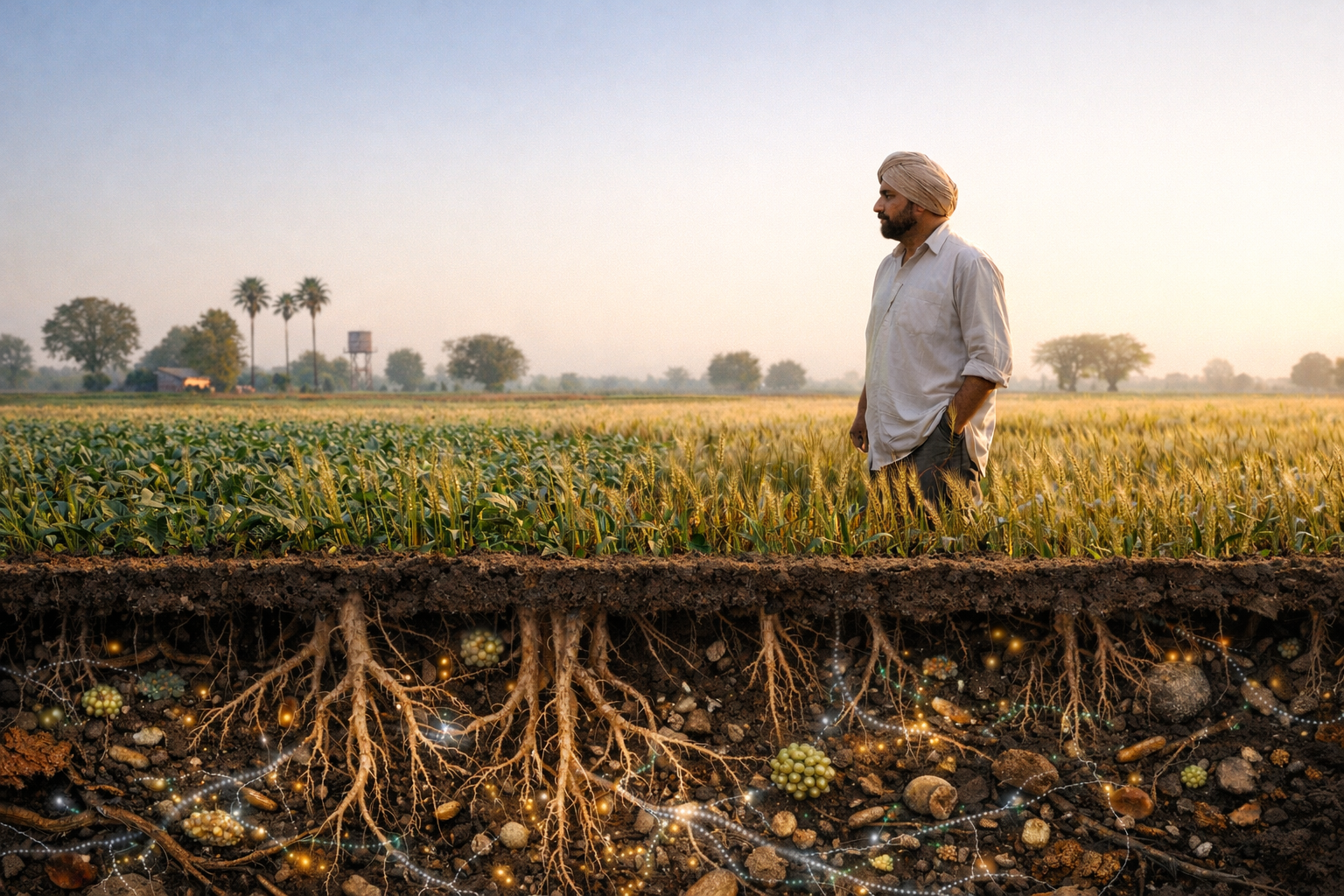
A decade ago, Mr. Brian Barth, a freelance writer grounded in urban planning, landscape design, and sustainable agriculture, wrote in the pages of Modern Farmer that feeding a planet of seven billion would require us to look beyond the crops we see and toward the vast microbial universe beneath our feet. His message was simple yet profound: real farmers do not merely grow plants, they cultivate soil. At the time, it was an optimistic, science-led call for a fundamental shift in how we think about agriculture.
As I worked on the Nexus3P Foundation’s forthcoming collaborative project on Soil Health in Punjab, I found myself revisiting Barth’s ideas. I undertook a deeper exploration to imagine what he might write today how he would reinterpret his original argument in light of current realities and the significant scientific advances that have reshaped our understanding of soil health over the past decade. Fast forward to February 2026, Mr. Barth’s plea has become a sprint. The world population has pushed past 8 billion, en-route to a projected 10 billion by 2050. But the goalposts have moved. We are no longer just asking how to produce 70% more food. We are asking how to do it while reversing soil degradation (which now affects 33% of global soils and a staggering 60% in Europe), slashing the 195 million tons of synthetic nitrogen that choke our waterways, and stabilizing crop yields under climate stresses that threaten to cut productivity by up to 70%.
The answer remains the same: microbes. But in the last decade, our understanding of how to deploy them has undergone a revolution. We’ve moved from observing the microbial world to engineering it. This is no longer just about nurturing native soil life; it is about a high-tech, interdisciplinary collaboration between chemists, geneticists, data scientists, and farmers.
Here is what the future of microbes led farming looks like in 2026.
1. The Nano-Shield: Making Bacteria Work Outside the Soil
For decades, the promise of nitrogen-fixing bacteria was largely confined to the root zone of legumes. Getting free-living bacteria to colonize the leaves (phyllosphere) or roots of staple crops like rice, wheat, and maize was a frustrating exercise in failure. The bacteria would die from UV radiation, desiccation, or simply wash away.
That limitation has been shattered. In a landmark study published just last month in Nature Food, a team led by Yiwen Liao demonstrated the power of “nanocoated” fertilizers. By encapsulating the nitrogen-fixing bacteria Klebsiella variicola W12 in a metal-phenolic network and sodium alginate, they created a protective suit of armor for the microbes.
The results are staggering. When sprayed on rice leaves, the nanocoated bacteria showed a 3.3-fold increase in colonization compared to bare bacteria. More importantly, these armored microbes contributed 27.89% of the plant’s total nitrogen—more than double that of their unprotected counterparts. In field trials, this translated to a potential saving of 74.38 kg of chemical nitrogen per hectare . We are no longer just feeding the plant; we are engineering a micro-climate where the plant’s microscopic partners can survive and thrive.
2. Green Chemistry Meets the Microbiome: Healing the Soil Itself
If nano-tech helps microbes survive on the plant, green chemistry is helping them rebuild the planet. Soil isn’t just dirt; it’s a living matrix. But what happens when that matrix is destroyed? Enter Professor Gabriele Berg, a microbiologist at the Leibniz Institute for Agricultural Engineering and Bioeconomy, and Professor Markus Antonietti at the Max Planck Institute of Colloids and Interfaces.
Their Max-Planck-Fellowship project, SHAPE (Sustainable Health through a Chemistry-Microbiome Partnership), is pursuing what they call a “therapy plan” for the planet’s degraded soils . Antonietti has developed a green chemistry process that mimics nature’s humification, taking plant waste and transforming it into humus-rich soil in hours, not years. Berg’s role is to infuse this synthetic humus with life. “We are creating a custom-made soil,” Berg explains. “It’s biologically active from the start, creating ideal conditions for microbial communities to thrive, restoring health, resilience, and balance”.
This isn’t just about fertility. It’s about carbon. This biologically active humus is designed to capture and store CO₂ long-term, transforming agriculture from a climate problem into a carbon sink. The invisible engineers beneath our feet are finally getting the habitat they deserve.
3. The Toolkit Expands: From Omics to Algae
Our ability to see and understand the soil has also matured. In 2014, we spoke broadly about “microbes.” Today, we have “omics-driven insights.” As detailed in a comprehensive review by Parveen et al. in the Journal of Basic Microbiology, metagenomics, transcriptomics, and metabolomics allow us to watch the soil food web in real-time, understanding exactly which genes are being switched on during a drought or a pathogen attack.
This new visibility has expanded our toolkit. We now know that the solution to phosphorus deficiency might not be a bacterium, but an algae. A 100-day study on tomatoes published in Plant Physiology and Biochemistry showed that combining bacterial inoculants with microalgae like Tribonema sp. didn’t just increase yield; it dramatically improved fruit quality, boosting fructose and vitamin C content. We are moving from monocultures of the mind to polycultures of soil management.
4. The Signals of Survival: Listening to the Rhizosphere
Perhaps the most profound shift is our understanding of how plants and microbes talk. It’s not just a random exchange; it’s a sophisticated signaling network. Under climate stress that is drought, heat, salinity plants send out distinct chemical SOS signals via their root exudates. As Mohapatra et al. outline in the journal Rhizosphere, these signals recruit specific beneficial microbes that can help the plant adjust its hormone levels, fortify its antioxidant defenses, or access deep water.
This understanding opens the door to “rhizosphere engineering.” Researchers are now exploring how we can breed crops for better “microbiome recruitment” or apply synthetic signaling compounds to trick the microbiome into activating stress defenses before the stress hits. A complementary review in Plant Gene even suggests integrating CRISPR/Cas gene editing with AI to predict and design the ultimate climate-resilient crop-microbe partnership.
The 20/20/20 Goal Revisited
Back in 2014, the American Society for Microbiology set a goal: a 20% increase in food production with a 20% reduction in fertilizer and pesticide use within 20 years. We are now at the halfway mark of that timeline. We haven’t hit the target yet, but for the first time, the path is clear.
We have the tools. We have the nano-carriers, the synthetic humus, the genomic sequencers, and the AI models. The bottleneck now, as Shashi B. Sharma and his co-authors note in their 2025 Microorganisms review, is “standardisation and stewardship”. Farmers have been burned by ineffective products before. The challenge for the next decade is to build the regulatory frameworks and quality control pipelines that turn these lab breakthroughs into reliable, trusted tools for the farmer.
The vision remains the same: a farmer is a steward of a universe, not just a manager of a field. But today, that vision is backed by a weight of evidence and a sophistication of technology that was barely imaginable in 2014. The revolution in the soil has finally reached the surface.
The ball is now in courts of soil scientists and soil health startups across the World. Dr. Rattan Lal, thank you for amplifying the message around soil health.
Tags: